

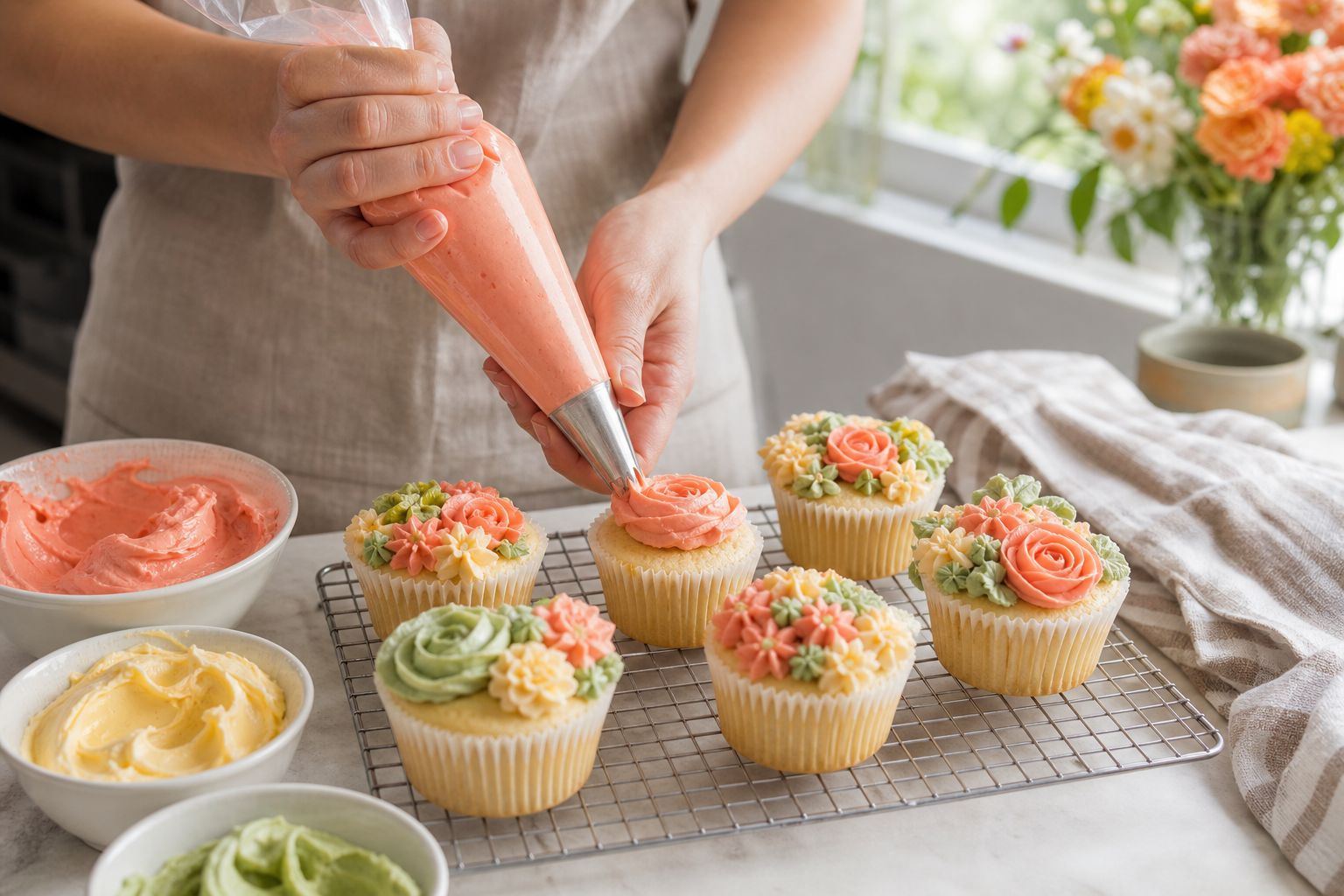
Buttercream flowers can turn simple cupcakes into a summer centerpiece, but warm kitchens make every weakness in the frosting more obvious. Soft icing rounds off petal edges, a warm cake can loosen the base, and an overfilled piping bag becomes harder to control. The good news is that you do not need professional equipment to improve the result. You need a stable plan: prepare the surface, adjust the frosting, choose the right tip, pipe in small batches, and protect the finished design from heat.
This guide focuses on decorating technique rather than a single recipe. Always follow the ingredient, storage, allergy, and food-safety directions for the frosting recipe you choose.
Start with completely cool cupcakes or cake
Never pipe onto a warm surface. Residual heat softens the butterfat where the frosting meets the cake, so a flower that initially looks crisp may slide or slump. Let cupcakes cool on a rack until the centers and bottoms no longer feel warm. If your kitchen is hot, move the cooled cakes to the coolest dry work area available before decorating.
Frost the surface with a thin base layer before adding flowers. That layer gives piped decorations something to grip. Wilton similarly recommends piping flowers onto an already iced surface so they attach more securely.
Choose a frosting consistency that holds detail
The correct consistency matters more than decorative speed. For dimensional flowers, the frosting should move through the tip under steady pressure but keep a ridge after the pressure stops. Wilton's flower-piping guidance recommends stiff buttercream or royal icing for flowers because softer icing can droop. Its buttercream consistency guide also advises making small adjustments: add confectioners' sugar gradually when frosting is too wet, or tiny amounts of liquid when it is too dry.
Make one adjustment at a time and test again. Too much sugar can make frosting difficult to squeeze and encourage cracked edges. Too much liquid can erase definition. A practice rosette on parchment should release cleanly from the tip and keep its grooves for several minutes.
Match the piping tip to the flower
Different tip families create different structures. A star tip makes fast rosettes and swirls. A drop-flower or Russian-style tip can form a multi-petal bloom with one controlled squeeze. A petal tip gives more control for roses, ruffles, and layered flowers. Wilton's current piping-tip overview explains how round, star, leaf, drop-flower, petal, and specialty tips change the result.
If you are building a small toolkit, Bake Everything's Piping Tip Nozzle Set offers a straightforward place to compare shapes, while the Silicone Icing Piping Bag Set gives you reusable bags for separating colors. Check each product page for current contents, availability, pricing, and care instructions before ordering.
Load the bag without trapping heat or air
- Fit the tip securely. Trim the bag opening a little at a time so the tip sits firmly without slipping through.
- Cuff the bag over your hand. This keeps the upper half clean and makes filling easier.
- Fill only halfway. A smaller amount is easier to control and spends less time warming in your hand.
- Press out air pockets. Push frosting toward the tip, then twist the open end to maintain pressure.
- Test on parchment. Confirm the shape and color before moving to the cake.
For two-tone flowers, paint a narrow stripe of one color inside the bag before adding the main color, or place two smaller filled bags inside one larger bag. Keep the palette restrained; two tones usually show petal structure more clearly than several competing colors.
Use steady pressure and a clean release
For a one-squeeze flower, hold the bag upright, touch the tip lightly to the iced surface, and squeeze long enough to establish the base. Ease off the pressure before lifting the tip. Continuing to squeeze while lifting stretches the flower into a peak. Wilton recommends keeping this type of flower short and cleaning buildup from the tip between flowers.
For rosettes, start at the center and move in a tight spiral while maintaining even pressure. Stop squeezing, then pull the tip away along the direction of the final curve. Vary the flower sizes slightly so the arrangement feels natural, and use small dots or leaves to cover gaps rather than crowding every bloom.
Work in short, cool batches
Your hands warm the bag as you pipe. In summer, divide frosting among two bags and alternate them. If definition begins to soften, pause and cool the frosting according to your recipe rather than adding large amounts of sugar automatically. Wipe condensation from the outside of a chilled bag before resuming so water does not reach the cake.
Frostings do not respond to heat in the same way. King Arthur Baking's hot-weather frosting comparison found meaningful differences in how common styles retained their shape. Use that as a planning reference, but follow a tested recipe and remember that no butter-based decoration is designed to sit indefinitely in direct sun.
Chill strategically, then transport carefully
Once decorated, let the flowers firm in a cool environment before moving the cake. A box protects the surface from airflow, dust, and accidental contact. Use a level vehicle surface, keep the cake out of direct sunlight, and cool the vehicle before loading. Bring a small repair bag with matching frosting and the original tip for quick touch-ups.
Food safety is separate from visual stability. Frostings containing cream cheese, whipped cream, custard, or other perishable ingredients may require refrigeration. USDA guidance notes that ordinary baked goods can differ from cakes with cream-cheese frosting or cream fillings, so follow the specific recipe's storage rules and keep cold foods at safe refrigerator temperatures.
Quick troubleshooting
- Flowers slump immediately: the frosting or room may be too warm, or the consistency may be too soft.
- Petal edges tear: the frosting may be too stiff, crusted, or insufficiently mixed.
- Air bursts interrupt the shape: press frosting firmly into the bag and work out pockets before piping.
- The flower pulls off with the tip: stop pressure before lifting and make sure the base layer is slightly tacky.
- Colors look muddy: use fewer shades, avoid overmixing, and keep separate bags for contrasting colors.
A simple summer workflow
Bake and cool first, prepare a stable frosting, test the consistency, fit and half-fill the bag, then pipe in short batches. Give the finished flowers time to firm and plan storage based on the recipe-not just on how the frosting looks. With those steps in place, a piping-tip set becomes more than a collection of shapes: it becomes a repeatable system for cleaner summer cupcakes and cakes.